
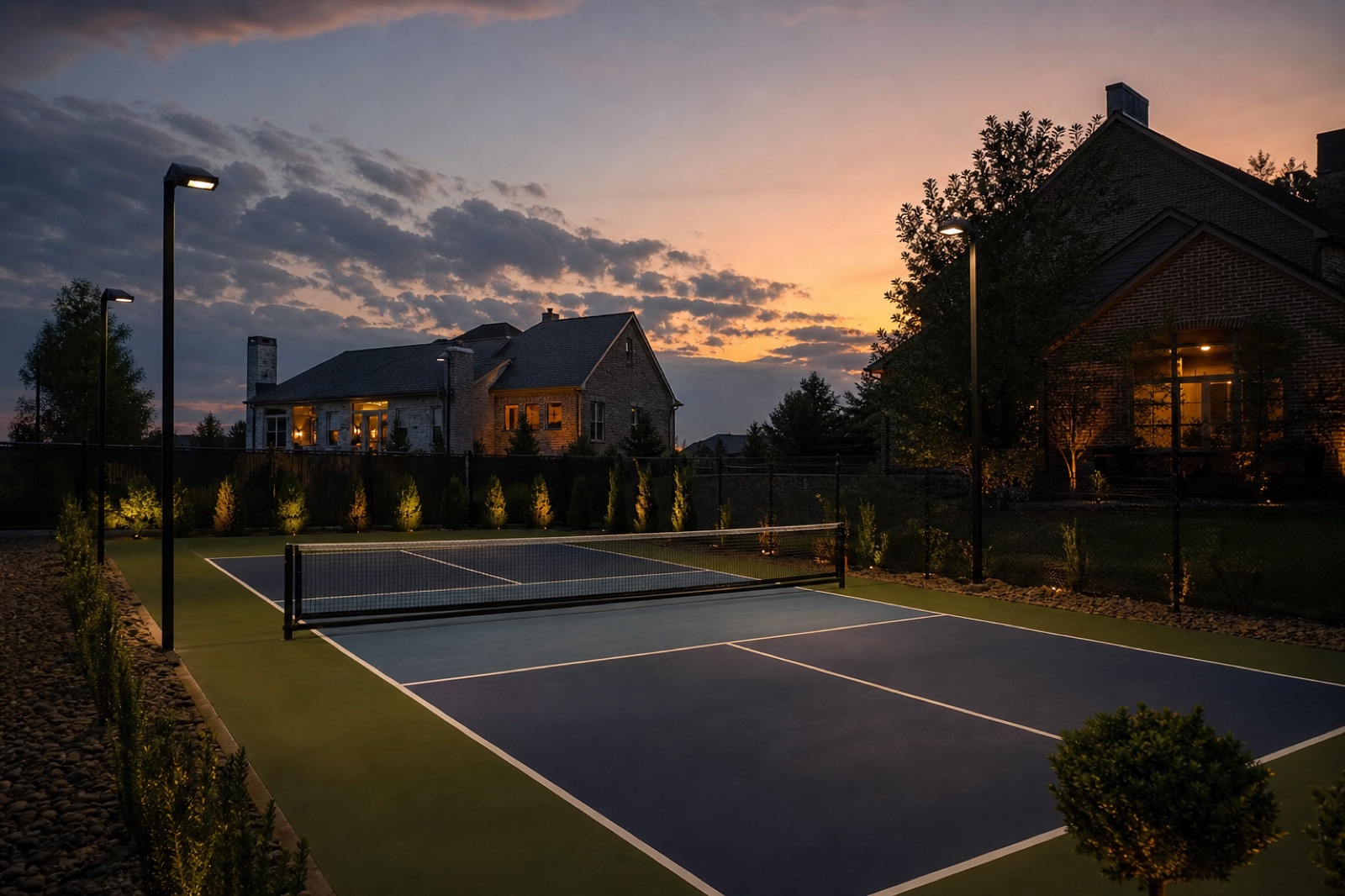
Residential
Prioritize spill control, neighboring homes, operating hours, smaller-scale infrastructure, and a comfortable property relationship.
Pickleball court lighting design & installation
A bright court is not necessarily a well-lit court.
The goal is not to flood the property with light. It is to place the right light where the game happens.
Send the court layout, intended playing hours, nearby property conditions, and details about existing poles or electrical service.
The lob test
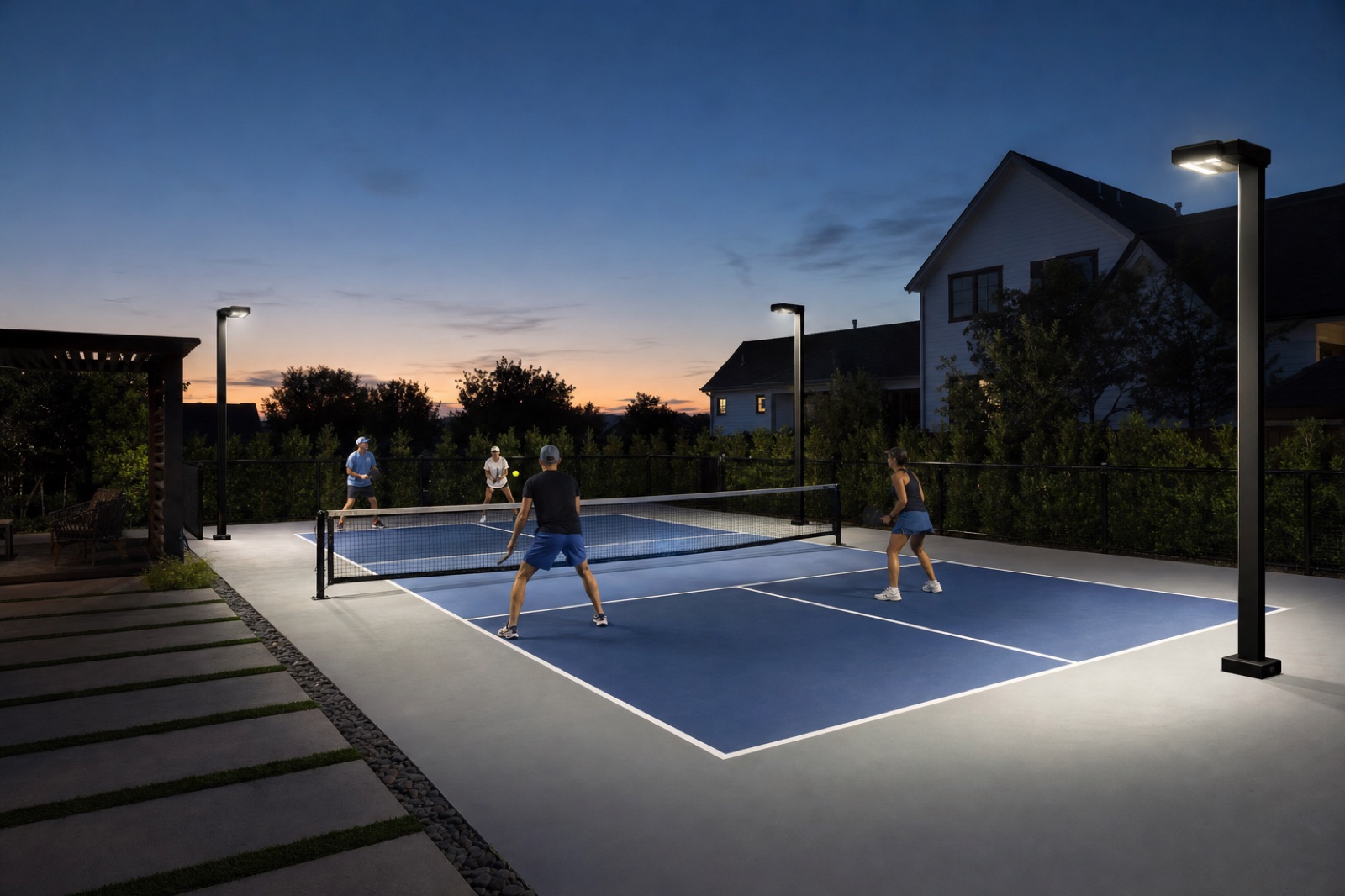
A system can measure bright while a fixture sits directly behind the ball. Pickleball moves through sightlines toward the kitchen, across the net, behind the baseline, and upward during lobs.
A useful plan balances illumination, uniformity, glare, shadows, color quality, spill, and operating controls rather than maximizing one number.
Illuminate the game—not simply the pavement.
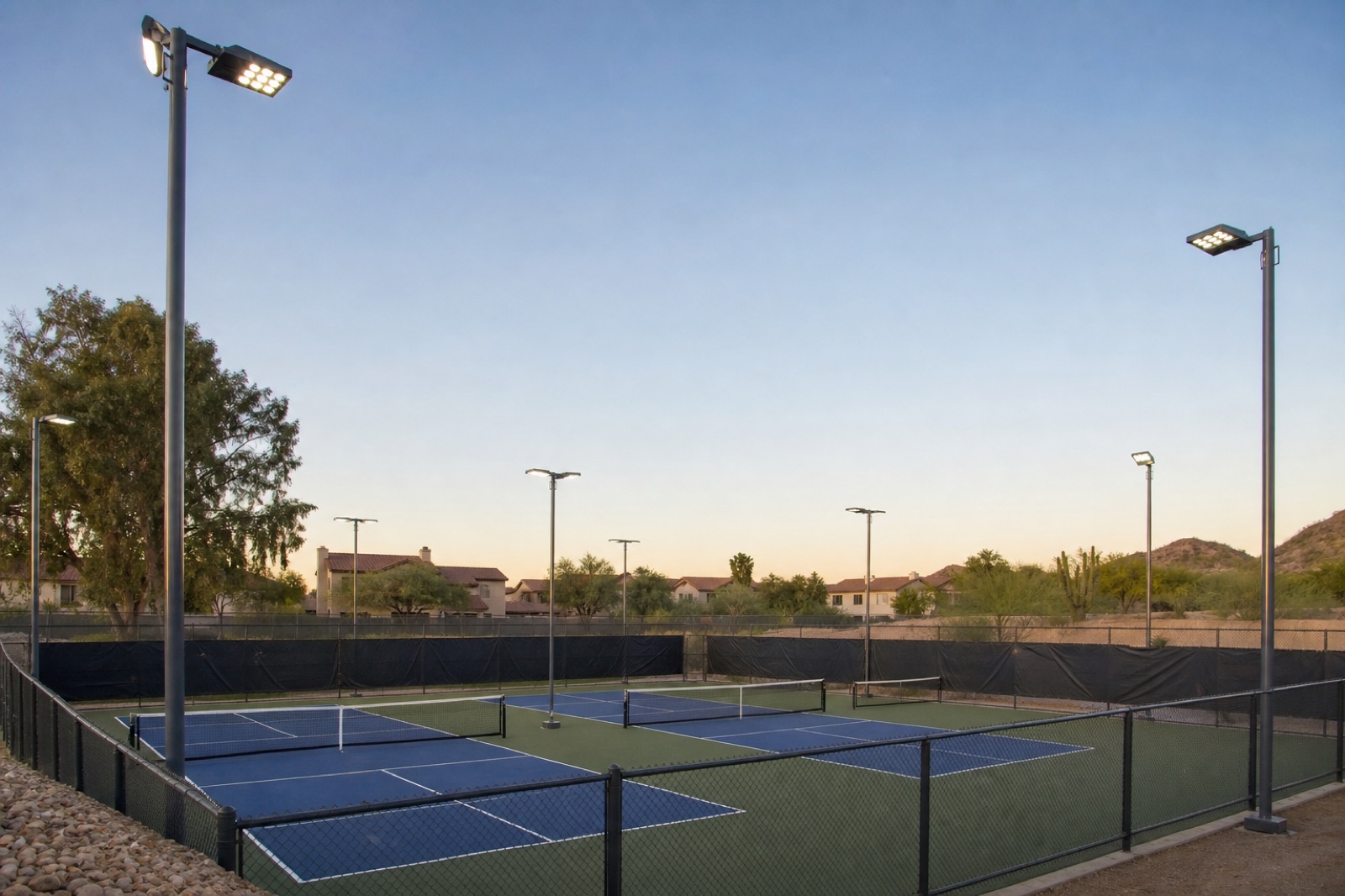
Lighting performance
| Factor | Design question | Failure to avoid |
|---|---|---|
| Uniformity | Does light remain consistent across kitchens and baselines? | Eyes readjusting during every rally |
| Glare | Can players track high balls without staring into fixtures? | The ball disappearing during lobs |
| Shadows | Do players, nets, fences, or poles create dark zones? | Uneven visibility around active areas |
| Spill | What reaches homes, roads, windows, and neighboring property? | Lighting beyond the area that needs it |
| Controls | Can zones, timers, or dimming match actual use? | Every fixture operating for one court |
One system, different settings
Both must coordinate sightlines, fencing, electrical service, drainage, foundations, and the surrounding property.
Prioritize spill control, neighboring homes, operating hours, smaller-scale infrastructure, and a comfortable property relationship.
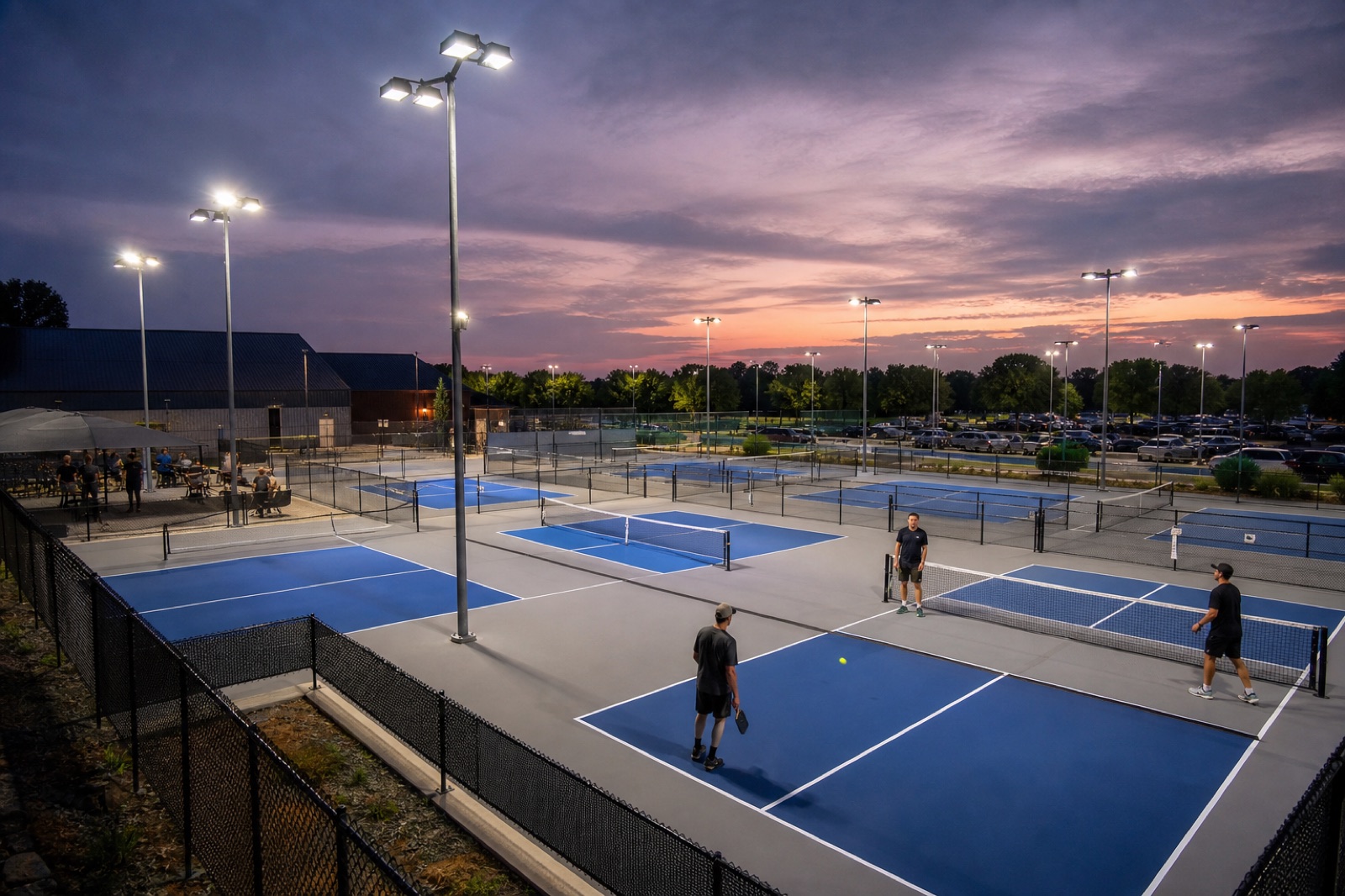
Coordinate multiple courts, uniform performance, separate controls, maintenance access, schedules, security, and energy use.
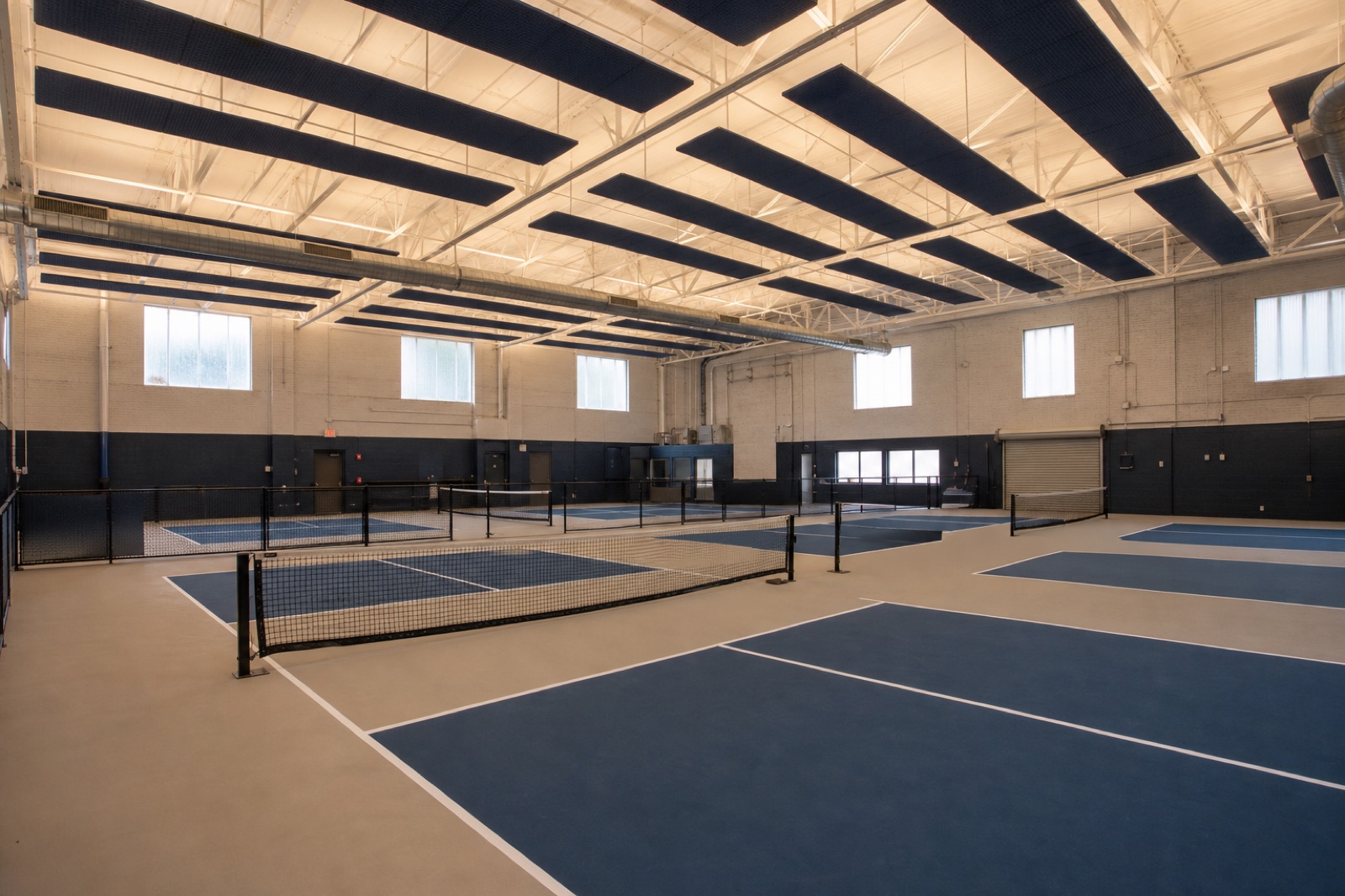
Account for clear height, structure, reflectance, windows, HVAC, direct glare, shadows, and fixture access.
Lighting process
Collect the court layout, property boundaries, nearby homes, existing service, poles, and operating hours.
Set the intended play level, court count, controls, energy goals, and maintenance expectations.
Coordinate poles, fixtures, aiming, fencing, run-off, foundations, conduit, and sightlines.
Review illumination, uniformity, shadows, glare, spill, and how the design behaves during a lob.
Complete foundations, poles, conduit, panels, controls, fixtures, and required trade coordination.
Commission the system after dark and correct aiming or controls before handoff.
Lighting FAQs
The fixture is one part of the result. Placement and control determine how it plays.
Reviewed July 2026. Court planning context was checked against USA Pickleball construction guidance (opens in a new tab).
There is no universal fixture count. Optics, mounting height, court count, intended light level, surrounding properties, and the selected layout determine the system.
General floodlights may create brightness while still producing uneven coverage, glare, shadows, and spill. Planned court optics provide better control.
Possibly. Poles, foundations, fixtures, wiring, aiming, and coverage must be tested against the new pickleball layout.
Separate zones can reduce operating cost and illuminate only the courts in use—especially useful for clubs, schools, parks, and HOAs.
Use fixture shielding, careful aiming, appropriate optics and mounting height, pole placement, timers, dimming, and a site-specific lighting plan.
Picture the final rally
Send the property address, court layout, intended hours, nearby homes and roads, electrical-panel location, existing poles, and wide photographs from every corner.