
Preliminary planning ranges
National industry ranges applied to early Kentucky budgeting.
| Project type | Preliminary planning range | Source or basis |
|---|---|---|
| Resurface a stable existing court | $6,000 to $15,000 | PickleTile resurfacing guide (opens in a new tab); SportMaster surface components (opens in a new tab). |
| Repair and resurface a damaged court | $10,000 to $25,000+ | Editorial planning estimate assembled from crack repair, preparation, drainage, and resurfacing components in the cited surface guides. |
| Basic new outdoor court with limited extras | $30,000 to $45,000 | SportMaster construction guidance (opens in a new tab); Angi court cost guide (opens in a new tab). |
| Complete residential outdoor court | $40,000 to $65,000 | SportMaster (opens in a new tab), PickleTile (opens in a new tab), and Angi (opens in a new tab) national ranges, adjusted for fuller scope. |
| Premium outdoor court with major upgrades | $60,000 to $100,000+ | Editorial planning estimate assembled from foundation, cushion, lighting, fencing, and site-work components in the cited guides. |
| Tennis-to-pickleball conversion | $8,000 to $30,000+ | Editorial planning estimate assembled from preparation, repair, surfacing, equipment, and divider components. |
| Multi-court commercial facility | Site-specific six-figure project | Editorial planning estimate; scale and amenities can move totals beyond Angi’s multi-sport range (opens in a new tab). |
| Indoor facility construction or conversion | Building-specific estimate | No generic total is applied; slab, building, lighting, acoustic, HVAC, access, and code scopes must be evaluated. |
Actual Kentucky pricing depends on the site, selected construction system, local trade requirements, material availability, and the complete project scope.
Compare like with like
The cheapest court and the cheapest rectangle are not the same thing.
A low proposal may include a slab, painted lines, and a portable net. A complete proposal may include site planning, excavation, soil preparation, aggregate base, drainage, foundation design, acrylic surfacing, permanent net posts, fencing, gates, lighting, electrical work, walkways, landscape restoration, and written warranties.
Both may use the phrase “pickleball court.” They are not pricing the same object. The number at the bottom only becomes meaningful when the work above it matches.
Six connected systems
Where the money actually goes.
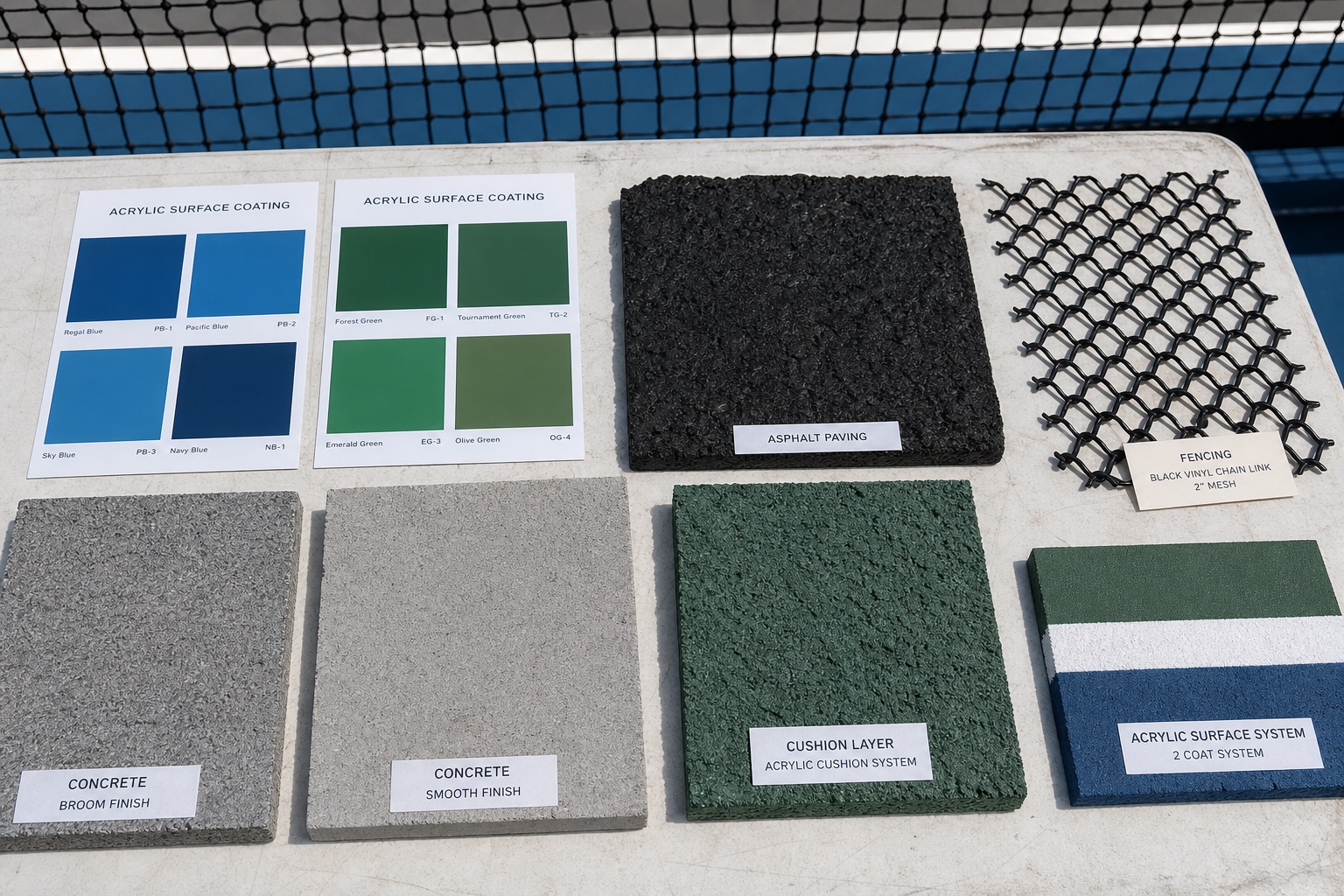
The colored acrylic is the most visible part of the court. It is rarely the largest part of the budget.
- 01
Site preparation
Clearing, excavation, grading, soil removal, rock, compaction, access, retaining work, and restoration.
- 02
Drainage
Finish grading, aggregate drainage, swales, catch basins, trench drains, underground pipe, erosion control, and edge stabilization.
- 03
Foundation
Asphalt, reinforced concrete, post-tensioned concrete, or an approved existing slab are materially different scopes.
- 04
Playing surface
Preparation, crack treatment, acrylic resurfacer, color coats, cushion layers, lines, logos, and court numbering.
- 05
Equipment and containment
Nets, posts, perimeter fencing, gates, dividers, windscreens, seating, shade, and storage.
- 06
Lighting and electrical
Photometric planning, poles, foundations, fixtures, controls, wiring, service capacity, trenching, and licensed electrical work.
Professional acrylic coatings are not ordinary exterior paint. The surface follows the base, so defects, depressions, cracks, and drainage problems must be addressed before the final color system is applied.
Project-specific budgets
Different court types create different scopes.
Backyard courts
Access, slope, nearby homes, landscaping, drainage, fencing, lighting, sound, and restoration can matter as much as the playing footprint.
Plan a backyard courtCommercial facilities
Multiple courts add circulation, accessibility, dividers, spectator areas, electrical infrastructure, operations, permitting, and construction phasing.
Explore commercial courtsIndoor courts
Existing slab condition, moisture, clear height, lighting, acoustics, dividers, HVAC, and building work determine the estimate.
Review indoor constructionConversions and resurfacing
The price begins with the condition of the existing pavement, cracks, drainage, slope, fencing, layout, and desired permanent equipment.
Review court conversionsWhy estimates move
What changes the final price?
- Available court footprint
- Number of courts
- Equipment access
- Slope and retaining work
- Soil, fill, clay, or limestone
- Drainage requirements
- Foundation selection
- Surface and cushion system
- Fencing and gates
- Lighting and electric service
- Accessories and amenities
- Walkways and restoration
A reliable estimate starts with the property. An address and wide photographs are more useful than a generic square-foot calculator.
Cost questions
What owners ask before requesting an estimate.
What planning range should I use for an outdoor court?
National industry guides support an early planning range around $35,000 to $65,000 for a professionally constructed outdoor court with meaningful site and court scope. This is not a KPCB average or a Kentucky market average. Site conditions and selected systems determine the proposal.
Why are online pickleball court estimates so different?
Some estimates price only a slab and lines. Others include site preparation, drainage, foundation design, acrylic surfacing, permanent equipment, fencing, lighting, electrical work, access, and restoration. Compare scope before comparing totals.
Is a backyard court less expensive than a commercial court?
Usually, but not always. A difficult residential property can require extensive access, retaining, drainage, and restoration work. Commercial projects add court count, circulation, accessibility, lighting, divider systems, and operational requirements.
Can you quote a court without visiting the property?
Photographs, an address, dimensions, and a description can support an initial review. A reliable construction proposal may still require a property visit, measurements, and clarification of soil, access, utilities, drainage, and desired features.
Reviewed July 2026. Sources include SportMaster construction guidance (opens in a new tab), SportMaster surfacing guidance (opens in a new tab), PickleTile’s 2026 guide (opens in a new tab), Angi’s pickleball guide (opens in a new tab), Angi’s multi-sport guide (opens in a new tab), and VersaCourt modular-court guidance (opens in a new tab).